Multiplayer
Build with other people
The street is shared. You can run it alone, and the game works that way — but the market, the courier routes and the community projects only exist because other players are on it too. The player market and community projects open when you create a free account, which is what keeps the economy fair for everyone.
Player marketplace
Sell what you make to the people who need it.
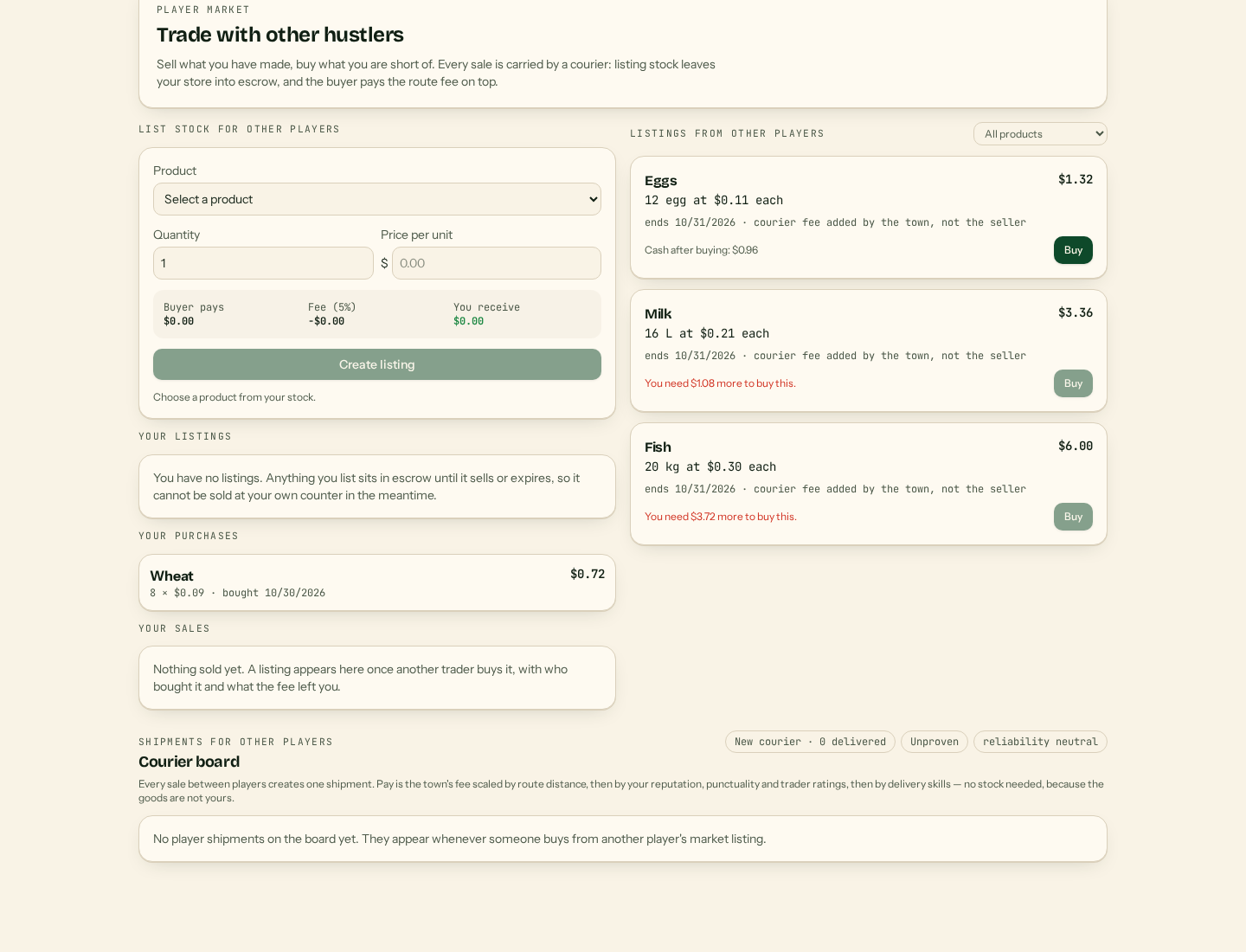
List surplus stock at your own price. The server moves it into escrow the moment the listing goes live, so a listing is always backed by stock you actually hold — and it comes back if the listing expires or is cancelled.
When another player buys, the sale settles on the server: the goods move, the cash moves, and a fee is taken on settlement. You cannot sell stock you do not have, and buying cannot be faked from the browser.
That is the first place another player's decision changes your numbers. A full shelf in your own shop and a full shelf in someone else's can be the same goods, priced differently.
Shared community projects
Pool cash toward something the whole street gets.
A community project has a target and a running total. Players contribute what they choose; when the target is reached the project completes and its effect lands on the town, not on one balance.
Contributions are recorded per player, so the project page can show who funded what without exposing anything private. A project that is not funded stays open rather than quietly expiring with the money.
Specialise, and let someone else do the rest
Ten trades, six paths, and no obligation to own the whole chain.
There are 10 trades to claim and 6 paths to build along. Claiming a trade opens its business a level higher, stocks a product you can sell immediately and starts its skill at level 2 — that is the real head start a specialisation gives you.
Because every business buys inputs and sells outputs, a player who only grows and a player who only cooks can both do better by trading than by owning everything. The chain does not require you to own all of it.
Courier work is the other side of the same idea: move other players' goods along a route, hit the deadline, and get paid for the distance.
Rankings and competition
The boards show who is holding the town's trade.
Demand share shows where the waiting customers are standing across your own counters. Market share shows how much of the stock on offer for a product is yours. Both read numbers the server already settles — neither is a forecast.
Competitions run on top of the same economy, so a place on a board is a record of what you actually sold rather than a separate score to grind.
Move other people’s goods
Courier work pays for distance, deadlines and your reliability.
A courier business can accept delivery contracts between places in town. Pay grows with the route and the load; a missed deadline and a low rating cost you the next job. The same routes carry other players’ shipments, so the board is a real economy rather than a scripted quest.
The details — fee, distance rate, deadline and the businesses that can carry — are in the logistics guide.
Your first sale does not need anyone else
Play alone first. The market and the projects are there when you want them.